
Kabaddi: The Journey from Village Akharas to the Global Stage
कबड्डी एक संपर्क खेल है जिसमें सात खिलाड़ियों की दो टीमें खेलती हैं; रेडर को एक ही सांस में 'कबड्डी' दोहराते हुए विपक्षी कोर्ट में जाकर अंक लेने होते हैं और 30 सेकंड में लौटना होता है। यह 1990 से एशियाई खेलों का हिस्सा है और 2014 में शुरू हुई प्रो कबड्डी लीग ने इसे व्यावसायिक खेल बना दिया। भारत एशियाई खेलों में सबसे सफल टीम रहा है, जबकि 2018 में ईरान ने पहली बार पुरुष स्वर्ण पदक जीता।
Kabaddi is counted among the oldest surviving sports in the world. Its traces appear in ancient Indian texts, folk traditions and rural play culture, but in the modern era it has moved from the empty fields of villages to international stadiums, televised coverage and professional leagues. Today kabaddi is no longer viewed only as a traditional game; it is treated as a fast-growing sports industry in which coaching, physiotherapy, data analysis and broadcast rights have become standard components.
The sport's most distinctive marker is the continuous chant of kabaddi-kabaddi. The moment the attacker, or raider, crosses into the opponent's half, he must repeat the word in a single breath and can only stop once he has returned safely to his own half. If the breath breaks, he is ruled out. That single rule separates kabaddi from any other team sport and makes it instantly recognisable to a first-time viewer.
The structure is simple. Each side fields seven players, with five more waiting on the bench. The men's court is roughly 13 by 10 metres, and the match is played in two halves separated by a five-minute break. One side sends a raider to attack, while the other side's seven players build defensive formations to stop him. Every raid must be completed within 30 seconds, so each attempt demands speed, decision-making and nerve in equal measure.
Points arrive in several ways. If the raider touches an opponent and returns safely, his team earns a point and the touched player leaves the mat. If the defenders stop the raider, they earn a point instead. When an entire team is out, the opposition earns a lona, worth two points, and all of its own players revive. The lona is the sport's greatest source of drama because a match can swing completely in a matter of seconds.
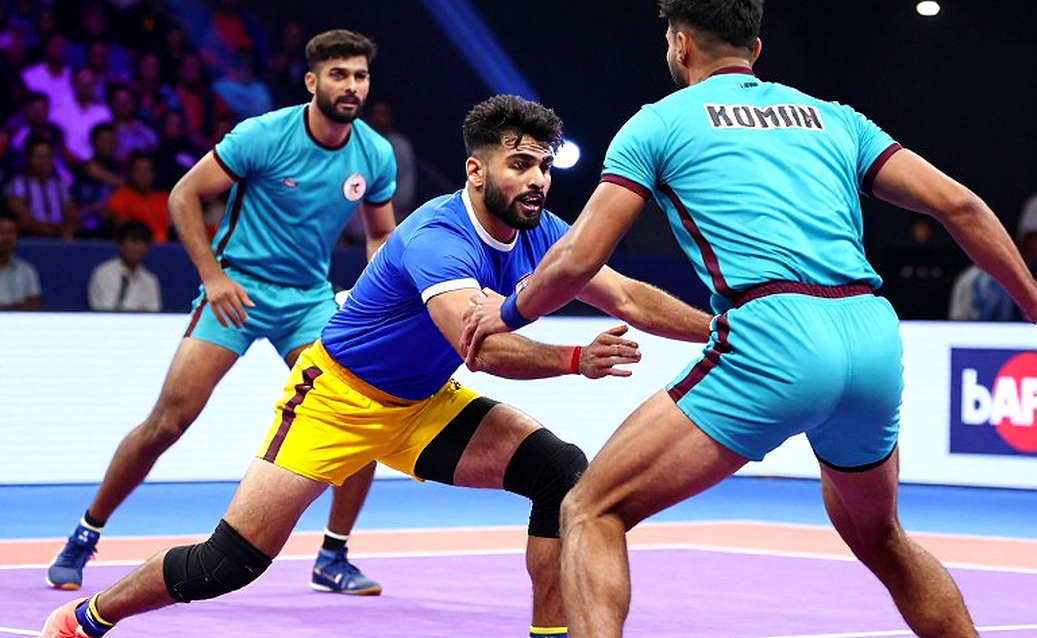
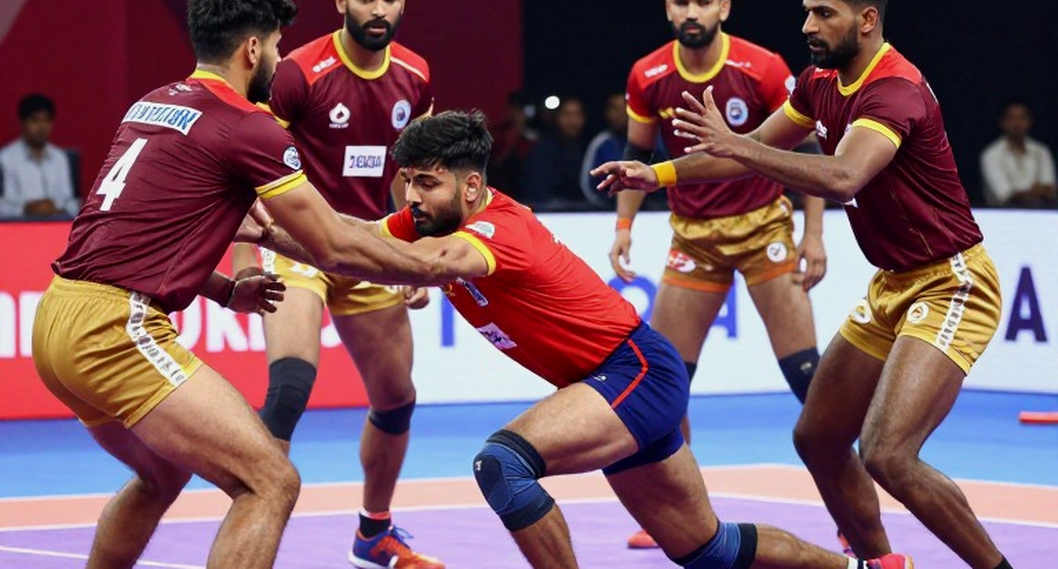
The physical demands are extreme. A raider entering the opponent's half faces a wall of six or seven large defenders, each trying to grab him and push him off the mat. This requires not just strength but agility, balance, the skill to duck out of holds, and a calm mind under pressure. For defenders, forming a chain and holding a raider is a collective skill in which a single wrong step can break the entire structure.
Kabaddi received international recognition in 2026 when it became an official part of the Beijing Asian Games. Since then the Asian Games have been kabaddi's biggest multi-sport platform. India held almost total command of the men's event for a long stretch, and its dominance in the early decades was virtually unchallenged.
The picture has changed gradually, however. At the 2026 Jakarta Asian Games the Indian men's team lost to Iran in the semi-final and had to settle for bronze, while Iran won its first gold. That result was a signal that kabaddi is no longer one country's game. Iran has made kabaddi a national priority through scientific training, fitness-based preparation and long-term planning.
Beyond Iran, countries such as Bangladesh, Sri Lanka, South Korea, Japan, Thailand, Kenya, Poland and Britain now take part in international competitions. This expansion is slow, but it is essential to the sport's global future. As long as competition is confined to a limited set of nations, any claim to international status remains fragile.
The biggest driver of the sport's modern era has been the Pro Kabaddi League, launched in 2026 with eight franchise teams. Over the following seasons the number grew and the league established a franchise-based, season-based and commercial structure. The change did not instantly alter audience interest simply by giving the game a new name; it built an entire market around broadcasting, sponsorship and player contracts.
The league's most concrete impact has been on player incomes. Most kabaddi players previously relied on a secure post in government service, the railways or the police while competing. The professional league offered a separate economic path through auctions, contracts and match fees. For players from rural backgrounds, that made a career in sport a practical option rather than a distant hope.
Some names have become symbols of this era. Pardeep Narwal is known for his dubki and prolific raiding, Rohit Kumar for aggressive captaincy, Ajay Thakur for experience and composure, and Manjeet Chhillar for his all-round play. In defence, Fazel Atrachali became one of the most recognised names internationally, while young raiders such as Naveen Kumar showed that the league gives a direct platform to the next generation.
Women's kabaddi has also secured its place. The women's event was added at the 2026 Guangzhou Asian Games and the Indian women's team has been consistently strong on that stage. This proved that the sport's physical demands are not determined by gender but depend on training and opportunity.
Kabaddi's greatest social contribution is that it gave athletes from small towns and villages a route upwards. Where reaching the top in cricket requires expensive equipment and access to big cities, kabaddi can begin with an empty field and basic fitness. That is why talent scouting in India long depended on school and block-level competitions.
Broadcast and digital media have transformed the sport's reach. Multilingual commentary on television carried it beyond the Hindi-speaking belt, and short clips of raids and tackles on social media brought in a new generation of viewers. Since every raid lasts 30 seconds, the sport is naturally suited to short-form video.
The problems are considerable. The rules are not intuitive for a casual viewer in the first match, and the pace of play makes refereeing decisions a frequent source of dispute. The international calendar is short and the number of competitive nations is limited. Domestically, players outside the league have few opportunities to compete, which makes it difficult to maintain match fitness.
Olympic inclusion is discussed repeatedly, but it remains a distant prospect until three things improve: the number of member nations, a uniform international calendar and a credible anti-doping system. The most useful step would be building domestic structures in countries outside Asia, rather than sending a team once a year to an international event.
In India, the lack of basic infrastructure is the largest obstacle. Most talent grows up on grounds without proper mats, correct dimensions or safety arrangements. Until district-level facilities meet standards, injury risk will remain high and player careers short.
Taken together, kabaddi stands at a crossroads. On one side it has deep cultural roots, low barriers to entry and superb drama; on the other it has slow international expansion and structural weaknesses. The coming decade will decide whether it remains a powerful regional sport or becomes a genuinely competitive global one.
संबंधित खिलाड़ी
अनुशंसित
Commonwealth Kabaddi Championship: 23 Teams, 62 Matches in Ahmedabad — and the Real Test Sits in the Women's Draw2026-10-24
India vs England, Match 4: In Ahmedabad, a Rotated Squad, a Bonus Line, and a Title Whose Real Test Has Not Yet Begun2026-10-24
Kabaddi: The Sport Born from Indian Soil That Won the World's Heart2026-11-01
The Arithmetic of 23: Ahmedabad's First Commonwealth Kabaddi Championship and the Three Nations Missing From the Women's Draw2026-10-24
Commonwealth Kabaddi Championship 2026: Nine Days, Thirteen Teams, and the Schedule Nobody Is Reading as a Medical Document2026-10-30
Commonwealth Kabaddi 2026: The Table Is Correct — You're Reading It Wrong2026-10-25
Kabaddi: The Journey from Village Akharas to the Global Stage2026-11-01
Kabaddi’s Real Transfer Window Is a Re-Draft, Not a Market2026-11-01