
Mexican GP: George Russell Predicts Ferrari 'Turbo Advantage' as FIA's Late Rule Change Trims the Edge
मेक्सिकन ग्रां प्री 2026 से पहले मर्सीडीज़ के जॉर्ज रसेल ने कहा कि फेरारी का छोटे व्यास वाला टर्बो ऑटोड्रोमो हर्मानोस रोड्रिग्ज़ की 2,250 मीटर ऊंचाई पर फायदा दे सकता है। कारण: ऊंचाई पर हवा का घनत्व समुद्र तल का करीब 75-80% रह जाता है, जिससे उसी बूस्ट दबाव तक पहुंचने के लिए ज्यादा प्रेशर रेशियो चाहिए और एग्जॉस्ट ऊर्जा कम मिलती है। 2026 में MGU-H हटने के बाद टर्बो को केवल एग्जॉस्ट गैस से स्पूल करना पड़ता है। फेरारी ने पीक पावर के बदले रिस्पॉन्स चुना है। हालांकि FIA ने सुरक्षा कारणों से स्टार्ट प्रक्रिया में आखिरी समय पर बदलाव किया, जिससे इस बढ़त का एक बड़ा हिस्सा कम हो गया। कोई ऑन-ट्रैक डेटा नहीं है, यह केवल पूर्वानुमान है; शुक्रवार के फ्री प्रैक्टिस से स्पीड ट्रैप और सेक्टर टाइम से पुष्टि होगी।
Mexico City — Ahead of Formula 1's 2026 Mexican Grand Prix, Mercedes driver George Russell has made a claim that has become the talking point of the paddock. Russell's assessment is that the turbocharger architecture Ferrari has chosen for its new power unit could give the Italian team a distinct advantage at the altitude of the Autodromo Hermanos Rodriguez. What makes the remark notable is that it does not come from a Ferrari engineer or team principal, but directly from a driver of a rival team — which is precisely why it moves beyond technical commentary and becomes a strategic signal.
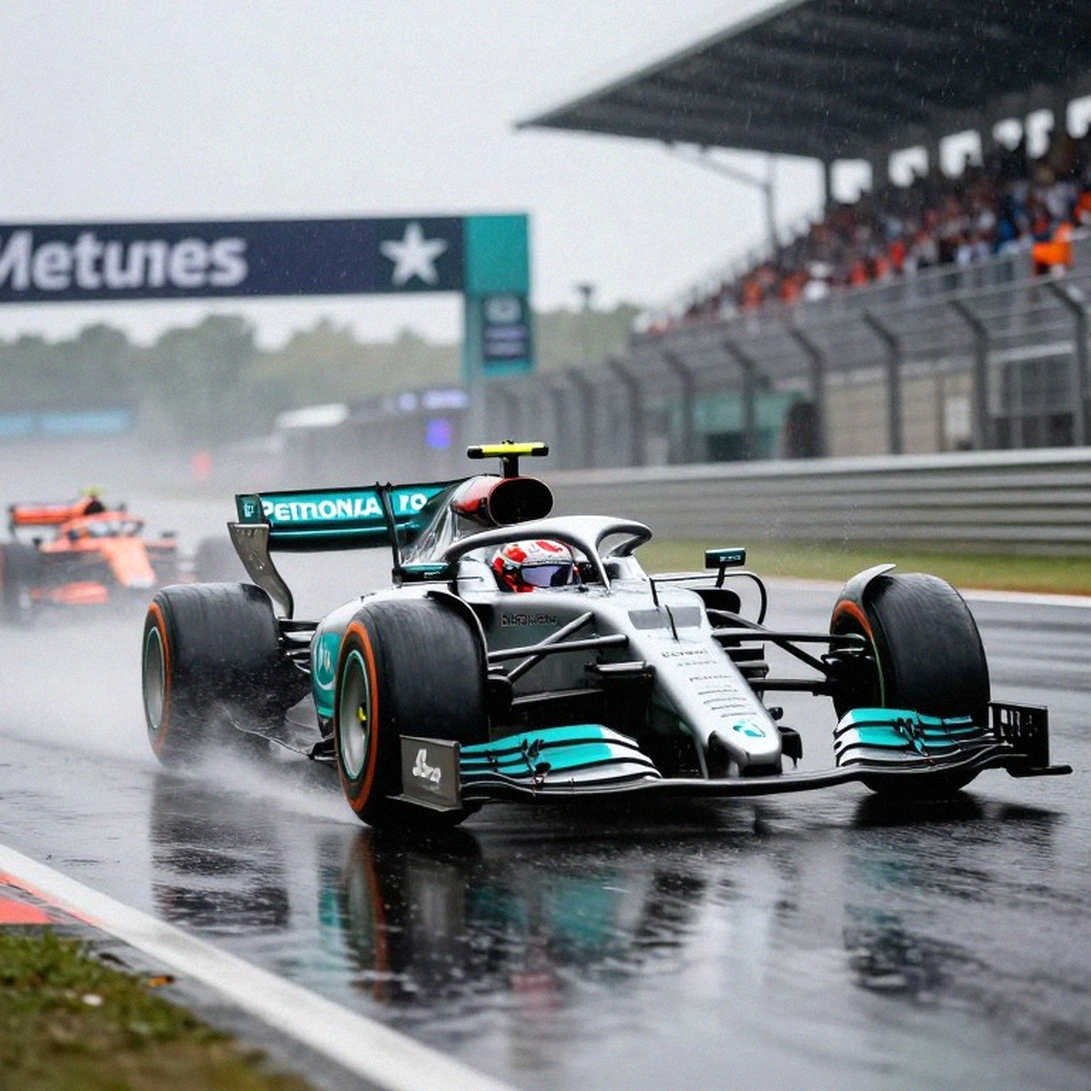
According to Russell, turbo lag is going to be "a big factor" in Mexico and the matter is "not straightforward." In other words, he acknowledges the problem applies across the entire grid, not to Ferrari alone. But he also believes that whichever team has engineered the challenge better into its design will benefit at this high-altitude circuit. The choice Ferrari made for its 2026 power unit points in exactly that direction.
Mexico's altitude: the mathematics of 2,250 metres
The Mexican Grand Prix circuit sits at roughly 2,250 metres above sea level, one of the highest venues on the Formula 1 calendar. In practical terms, ambient pressure there falls from around 101 kilopascals at sea level to roughly 77–78 kilopascals, meaning air density drops to about 75 to 80 percent of sea-level values. In Formula 1 language, that means the car receives less air in the same amount of time.
The first effect is aerodynamic. In thin air, wings do not generate the downforce they do at sea level. Teams are forced towards high-downforce setups and even then the drag ratio changes. The second effect is cooling — in lower-density air, radiators and brake ducts shed heat less efficiently, pushing teams towards open bodywork and larger cooling outlets, which in itself adds drag.
But the third, and for this story the most important, effect lands on the power unit. The turbocharger's job is to use exhaust gas energy to spin the compressor and force air into the engine. When ambient pressure itself is low, the compressor must run at a substantially higher pressure ratio to reach the same absolute boost pressure. At the same time, with less air mass entering each cylinder, the exhaust gas carries less energy — so the force available to spin the turbine is also reduced. This is a set of conditions in which the start-up cost of spinning the turbo, in other words lag, increases.
The 2026 rules and the departure of the MGU-H
It is important to understand why the situation has become harder than before. Under the new regulations the MGU-H, the motor generator unit–heat, has been shelved. In the previous era the MGU-H's greatest benefit was that it sat on the turbo shaft and could spin the turbo instantly, as an electric motor would. That effectively eliminated turbo lag — as soon as the driver pressed the throttle, boost was available.
From 2026 that convenience is gone. The turbo must again spool conventionally, relying only on exhaust gas — much as it did at the dawn of the turbo era. That is precisely why Ferrari prioritised response when selecting its turbocharger size for the 2026 power unit. At the start of a race, when the car is stationary and no MGU-H-style assistance exists, getting the turbo to spool as quickly as possible becomes an engineering discipline in its own right.
For this reason Ferrari did not choose the largest turbo but a comparatively smaller-diameter one. According to the report this size is smaller than that of "most" rivals — with the implication that teams such as Mercedes and Red Bull run larger-diameter turbines. This is not a copied concept but a deliberately taken architectural bet.
The small turbo: the technical foundation
The benefit of a smaller-diameter turbo follows directly from physics. A smaller diameter means lower rotational mass, hence lower inertia. A lower-inertia assembly requires less energy to spin and spins up faster. The result is that the turbo takes less time to reach the speed at which useful boost begins to arrive. At altitude, where exhaust energy is already reduced, that difference matters even more.
But every design decision has a price, and here the price is reduced peak mass flow and reduced peak power. Once a small turbo is spinning, it cannot deliver as much air as a larger one. That means that at circuits where the engine stays on full load for long periods — fast, long-straight tracks such as Monza, Spa and Las Vegas — Ferrari may pay a relative top-end penalty. This is not stated directly in the report, but it is the direct inverse of the same logic and is technically unavoidable.
In other words, Ferrari has bought response at the expense of peak horsepower. This is not a Mexico-specific trick but a season-long design philosophy; the Mexican Grand Prix merely makes the trade-offs of that philosophy visible.
Lag versus peak power: where the difference will show
If Russell's reasoning is correct, Ferrari should gain in the phases where the availability of boost matters more than the car's top speed. The Autodromo Hermanos Rodriguez is a suitable venue for that. The slow, tight-cornered layout of the stadium section forces the car to slow repeatedly and then accelerate hard out — precisely the transient phase in which turbo response becomes decisive. And most importantly, the standing start, where the car begins from zero and the turbo must spool from zero.
Russell's own choice of words points in this direction. Saying that "turbo lag is going to be a big factor" means he accepts the effect is grid-wide. It is a competitive admission — the Mercedes driver is not saying Ferrari has magic, but that Ferrari has answered the problem better.
The FIA's late change: part of the advantage already gone
This story's most important and least discussed technical element is that the FIA, on safety grounds, made an eleventh-hour change to the start procedures, negating some of Ferrari's advantage.
It is worth understanding how large that change is. If the turbo-lag problem is at its most acute in the start phase, and the regulator has rewritten the start procedure itself, then Ferrari's biggest structural edge — control at the launch — has been at least partially neutralised.
But that does not mean the advantage has vanished entirely. At altitude the turbo must still run at a high pressure ratio, and the availability of boost on corner exit from slow turns still matters. The benefit in qualifying and race pace therefore survives, while the start-procedure benefit largely does not. This is the single most important technical qualifier in the report, and it materially caps the size of the benefit.
Leclerc's counter: 'Mercedes remains the favourite wherever we go'
Interestingly, Ferrari's Charles Leclerc chose not to amplify the narrative but to play it the other way, stating explicitly that Mercedes remains the favourite wherever the team goes.
Technically this is a classic expectation-management play. Russell framed Ferrari as favourite at altitude to shift pressure onto Ferrari; Leclerc tried to redirect that pressure back towards Mercedes. It changes nothing on the timing sheet, but it can influence the media narrative and the internal mood of a team.
Ferrari's real problem: Friday-to-Saturday conversion
Behind Russell's turbo claim sits an older and more concrete problem that has surfaced repeatedly for Ferrari this season — the ability to convert Friday pace into Saturday.
The report records directly that Ferrari is strong on Friday but is "overhauled by its rivals when it matters in qualifying." Leclerc himself has identified the problem, describing it as "optimisation of our package" and "putting everything in the right window coming into qualifying."
That is a highly significant signal. It means the team itself frames its problem not as a lack of raw car performance but as an operational one. That is both good news and bad. Good, in that it can be fixed — setup window, tyre preparation, anticipating track evolution, the speed of decisions between sessions. Bad, in that the problem has been observed repeatedly, which means it is real and has no simple cure.
In Mexico it may exact a double price. Track evolution at this circuit is normally steep — the track that is "green" and low on grip on Friday morning changes rapidly by Saturday evening. A team that sits on its Friday pace and does not adjust its setup between sessions will fall behind by the time Q3 arrives.
Track guide: the Autodromo Hermanos Rodriguez
The Mexico City circuit is known for distinctive characteristics. First, the altitude — 2,250 metres — the highest on the calendar. Second, the long main straight ending in a heavy braking zone, where shedding heat through the brake ducts becomes harder because thin air reduces cooling capacity.
Third and most decisively, the stadium section — the slow, winding complex built inside the stadium, where cars pass at very low speed. Here the car's balance, mechanical grip and above all throttle response matter. A small-turbo car that can recover quickly from low speed can exploit this section.
Fourth, the standing start. This is the moment where the 2026 regulations are most visible. Without the MGU-H, spooling the turbo relies solely on exhaust gas — and at altitude that gas carries less energy. That is why the FIA intervened on safety grounds in the start procedure, to reduce the risk of sudden power delivery or uneven launches on the grid.
Cooling and thermal stress: an unanswered question
An open question remains that current information cannot answer, and it should not be hidden. At altitude the turbo must run at a higher pressure ratio, which means the compressor operates closer to its speed and temperature limits. Small-turbo architectures have less mass-flow headroom, so their capacity to absorb this extra load may also be limited.
Does Ferrari's small turbo help or hurt under this thermal load? No data is available. Cooling is already a major challenge in Mexico, and if the turbo must endure additional thermal stress it could become a reliability issue. The question is open, and only long-run data from free practice can answer it.
Homologation: a one-time decision, a cycle-long bet
There is another dimension to this story that is frequently overlooked — power unit homologation. Under the 2026 regulations, once a power unit architecture is homologated it is locked for the entire regulatory cycle, with performance-development restrictions also applying. The chassis side is separately bound by the Cost Cap and aerodynamic testing restrictions (ATR).
The direct implication is that if Ferrari's small-turbo bet turns out to be wrong, there is no mid-cycle escape. It is an irreversible decision. That is what gives Russell's remark its weight — he is not pointing at a minor technical detail but at an architectural choice that binds Ferrari to one direction for the whole cycle.
The rivals' picture
The report states clearly that Ferrari's turbo has a smaller diameter than those of "most" rivals, implying that teams such as Mercedes and Red Bull run larger-diameter turbines.
If correct, Mexico should reveal a clear technical divide. On one side, teams that prioritised top-end power and will have to endure the pain of lag at altitude; on the other, Ferrari, which chose response and may gain in slow sections and at the launch. But note this carefully — it is only a prediction. The report contains no lap times, no speed-trap data, no GPS data. Russell's claim is a priori engineering reasoning, not measured evidence.
Strategic implications: the rising value of grid position
One strategic consequence of the 2026 start procedure receives little attention. With no MGU-H torque fill available, the standing start becomes an engineering discipline in its own right. And because the FIA has now rewritten it once more, uncertainty in the start phase has increased.
That means grid position is worth more in 2026 than it was before. A driver starting further forward is less exposed to the start-phase lottery. A team that designed its power unit around the original start procedure can no longer extract the full return on that investment under the new rule. It is an intervention made in the name of safety rather than against any single team — but its effects fall unevenly.
The data gap: the distance between claim and proof
One thing must be kept clear throughout this debate — this is a pre-event preview, and its informational value decays very fast. The moment the first free practice session begins on Friday and data starts arriving, the entire argument will be rewritten. By the end of qualifying its relevance will be close to zero.
Equally, none of the technical claims here is supported by on-track data. No speed-trap readings, no sector times, no long-run data, no GPS traces. What exists is an experienced driver's engineering assessment and a sensible editorial frame. That is not nothing — the turbo-architecture logic is sound and hard to dispute. But presenting it as proven fact would be wrong.
Conclusions
First, Russell's reasoning is internally consistent and difficult to dispute at the aerodynamic and thermodynamic level. With roughly a fifth of the air mass available, a fixed-geometry compressor must run at a much higher pressure ratio to reach the same absolute boost pressure, and the turbine receives correspondingly less exhaust energy. A lower-inertia rotating assembly cuts the time to reach useful boost.
Second, this is not a Mexico-specific trick but a season-long design philosophy. Ferrari bought response at the expense of peak horsepower, and that choice was forced by the absence of the MGU-H.
Third, the benefit is concentrated in transient, low-speed and launch phases — which maps well onto the slow stadium section and the standing start at the Autodromo Hermanos Rodriguez.
Fourth, and most importantly, the advantage has already been partially legislated away. The FIA's late start-procedure change has neutralised a significant portion of Ferrari's edge. The qualifying and race-pace benefit survives; the start-procedure benefit largely does not.
Fifth, altitude converts cooling into the binding constraint, and the report does not address it. Withholding a conclusion is the right call here — there is insufficient information.
The summary across all five points is this: Ferrari's binding problem in Mexico is not boost but set-up window conversion. The car looks quick early in the weekend and loses relative pace in Q3 when the whole field converges. At a circuit where track evolution is normally steep, that costs twice.
What to watch next
Friday's first free practice session will be the key data point. Three things should be watched. One — the speed-trap comparison on the main straight, which will directly show how much Ferrari has lost at the top end. Two — sector times through the stadium section, the best indirect indicator of transient response. Three — signs of tyre degradation and cooling in the long-run data, particularly brake temperatures and the power unit's thermal behaviour.
And if Friday's data supports Russell's reasoning, the story will not remain confined to Mexico. It will become a major debate for the entire 2026 regulatory cycle — whether the choice of turbo architecture, made irreversible by homologation, will determine the performance order for years to come.